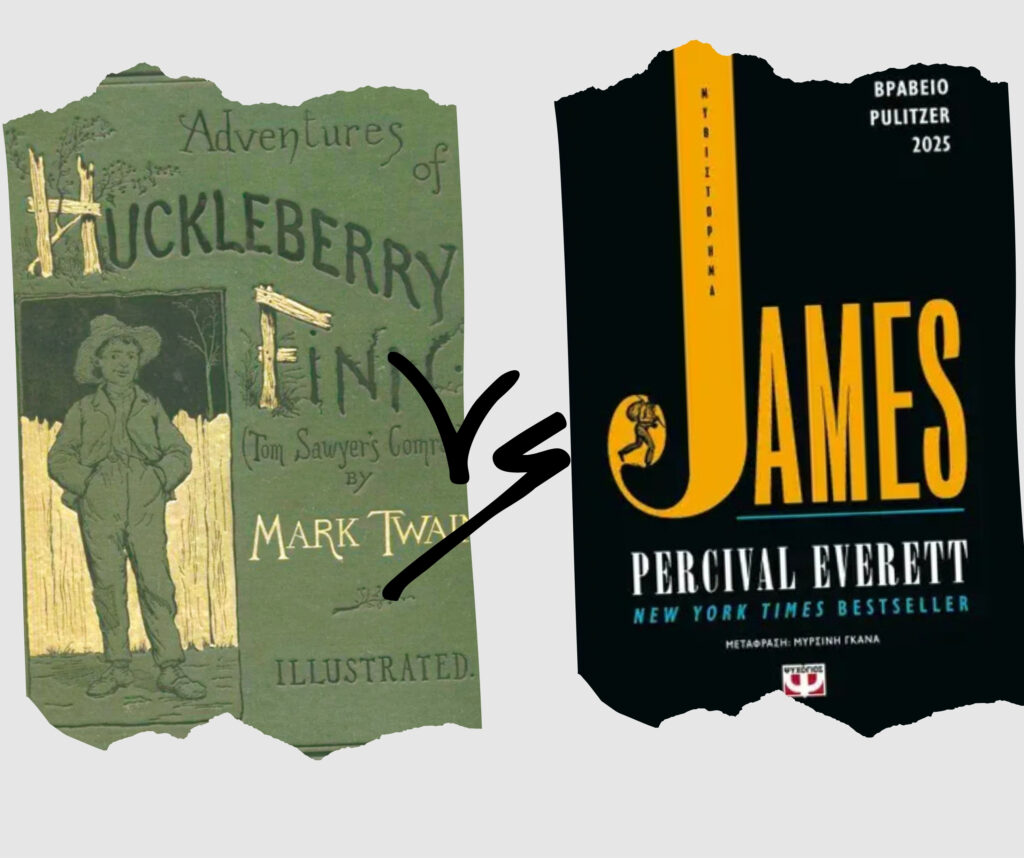
A parallel reading or a juxtaposition, at times the one and at times the other, exactly as Everett himself might have wanted, given that before writing James he read Huckleberry Finn fifteen times—even though the first ten might well have sufficed.
Huckleberry Finn is a picaresque novel, written in the second half of the 19th century, in the vein of Mark Twain’s other works, chiefly Tom Sawyer. It is a first-person narrative by a boy of humble background who recounts, in his own dialect, the episodes of his life, with a satirical undertone among other things. The picaresque hero does not undergo many linguistic or moral transformations.
What changes in Huckleberry Finn? The presence of the enslaved Jim, and the moral core of the book. The dilemma is no longer, as in Tom Sawyer, the quest for a white boy’s personal freedom. Huck consciously chooses to help a slave escape, knowing full well that legally, religiously, socially, etc., such an act is punishable. The central theme of Huckleberry Finn is one as old as antiquity—already present in Antigone: what is moral and what is lawful. For deep in his (American) soul, Huck knows that Jim is a human being, and should not be a slave.
The novel opens with a disclaimer by Twain: it uses seven different Southern dialects, all of them, he insists, real—dialects he had heard or used. Already in 1885, when it appeared in America, the novel was ridiculed for these dialects and scandalised readers with its anti-racist theme. Let us not forget that the story is set on the eve of the American Civil War, in the South, and was written a mere ten years after it. Passions were burning hot. And, 150 years later, in America, they still smoulder.
It was precisely this language that the good ladies and gentlemen of the day seized upon in their reviews, burying Huckleberry Finn and condemning it as a book that promoted immorality and licentiousness among the young. It took nearly forty years, and the turn of the century, for Hemingway and T. S. Eliot to rediscover Twain’s novel and establish it in the Canon—though both of them objected to its ending. For at the end Tom Sawyer reappears and torments Jim, placing him in a “romantic adventure” even though he already knows that Jim has been freed in his owner’s will.
Huckleberry Finn was taught in nearly every American school for most of the 20th century, only to be removed from curricula in the 21st, because it is filled with the hated n-word.
Percival Everett is a Black writer, and in 2022, during a tennis match, he conceived the idea of telling Huck Finn’s story from the slave’s point of view—making Jim the narrator and central figure. But Everett is not just any Black writer: he is over sixty, has written nearly thirty books, has taught creative writing and language all his life, and is a scholar with enormous love for language and education. He believes that if anything can redeem the Black community, it is precisely this—we see it already in his early works, such as Erasure.
Thus he creates a narrative belonging to what is called the neo-fugitive tradition (Black writers who were not themselves slaves, but are descendants of slaves, writing about slavery and the long road toward liberation) while simultaneously producing a spin-off of one of the most beloved and widely read American novels.
In the first part he follows Huckleberry Finn’s plot to the letter—at least those sections in which Jim appears and could plausibly recount the episode as a first-person narrator. He harnesses the flow of the picaresque, making James immensely readable—especially if you read Twain in your adolescence and no longer recall the details of each episode.
In the second and third parts, everything changes, because it must.
Everett writes with intention. His central theme is the demand for freedom—no longer the freedom of a white boy, but that of a Black man. From the very first scene, he overturns the cliché in Twain’s novel: the notion that Jim is kind-hearted but dim-witted, an uneducated believer in superstitions and the mental traps of religion. In fact, Everett’s Jim rises far above this. The dialect he speaks is a fabricated construct, one he is forced to teach to children in order to reassure white people that Blacks are inferior.
This literary device—don’t bother searching, there is no factual study supporting it; it is an Everettian invention—the idea that language is used as a pacifying tool of the oppressor, a sign of submission, and that Jim gradually sheds this language as he escapes slavery and becomes the master of himself, reinventing and renaming himself—James—supports the second level of reading. James is a coming-of-age novel, a search for identity, and ultimately a narrative of empowerment. Naming the self.
Along the way, each retold episode from Huckleberry Finn becomes a lesson in American history and an excavation of the American soul—which, surprise, includes the Black race. What is remarkable in James is that everything works: the fabricated Black dialect, the speech of uneducated whites, the strong humour (which echoes Twain), even Jim’s imagined conversations with Voltaire and John Locke—all Everett’s inventions—work in service of telling once again a shocking story: how people were treated as objects, “property”; how slaves had no families; how Black women were raped casually, as everyday routine; how one could be tortured to death and proudly hanged in the town square for a piece of lead. Above all, that all of this was legal. That is the outrageous, unthinkable part. The law, society, morality, religion all sanctioned it. But Jim tells us from the very beginning: he does not believe in any god, because that god is the white man’s god.
One of my favourite episodes is the re-imagining of the minstrel shows, in which white performers in blackface pretended to sing Black songs. Daniel Decatur Emmett is a historical figure; he existed, and so did his book of “songs,” which survives to this day (don’t ask about real Black songs and whether any were authentically printed). One of Emmett’s pieces—that falsehood—is the very first thing we read in James.
In this episode Jim realises that even from liberal whites he has nothing to expect—that if he waits for liberation, it must again come from a white man. And he rebels. In the second and third parts, once we leave Mark Twain behind, Jim is already free—even if he is not. Gradually he finds himself, becomes violent where he must, rises up, leads. And at last he becomes Just James.
This final phrase, so resonant in English and nearly impossible to render fully in Greek—“Δίκαιος Τζέιμς,” “Μόνο Τζέιμς,” “Απλά Τζέιμς,” etc.—is the core. Jim can finally define himself: he is consciously the master of his own being, and he has a name.
Thus James becomes far more than a literary game of shifting narrators and linguistic devices. By selecting a different narrator for the same story, Everett alters not only the stakes of the narrative but the narrative itself. At one point, as Jim begins to write his story with that splinter of pencil soaked in blood, he says: “With my pencil, writing gives substance to myself; by writing I am here.” Whoever acquires a voice acquires consciousness—and a place in History.
With James, Percival Everett experienced something in America he had not experienced before, despite his many remarkable books: he became famous, appeared on television, gained a platform. All his life he had supported the Black community discreetly—this is always held against him, and he satirises it in Erasure, the accusation that he was never “Black enough” as a writer. But here he clearly changed his political stance. He stepped forward, like James. The times, unfortunately, demand it. For 150 years later, racial equality is still an open demand. In America—but here in Greece as well.
Katerina Malakate